Monday, August 2, 2010

Summer Sizzle

Todd's Conservation Minnesota outlook for the Twin Cities and all of Minnesota

Tuesday: Very warm and humid. Looking brighter, but an isolated PM shower or storm still possible. High: 91

Tuesday Night: Partly cloudy and mild. Low: 70

Wednesday: Stray PM storms possible, otherwise warmer and still humid High: Near 89

Thursday: Mostly sunny and comfortable. High: 84

Friday: Looking dry and pleasant. High: 84

Saturday: Warmer with more humidity and a few pop-up storms possible. High: 85

Sunday: Scattered showers and thunderstorms. High: 89

Monday: Front moves through, probably dry, but warm. High: 87


The Summer Sizzle

Not sure I'd want to take a cruise in the Caribbean at this time of the year, but if you're brave enough to skirt through growing and swirling clusters of thunderstorms in the warm oceans waters, you might find some mighty fine deals. An active 2010 Atlantic Hurricane season is expected, but has been fairly dull to start. Officially, we are starting the third month of a long 6 months season, which wraps up on the 30th of November. Alex, a category 2 hurricane, fizzled along Mexico's northeast shore in the Gulf of Mexico and Bonnie, only beefed up to tropical storm strength. Interestingly, this is pretty close to average. Things begin to ramp up significantly in August and September as the upper level winds in the tropics die down and the ocean waters hit their max temp. According to the National Hurricane Center, an average of 2.8 storms form in the month of August and September, the most active month, sees an average of 3 named storms. By September 24th, the average season has 4 hurricanes. Unfortunately, I fear the worst is yet to come.

Closer to home, a steamy, sticky sun will rule the roost for a couple of days, but sunny, less humid air will slide in by the end of the week. Have a good Tuesday - Todd Nelson

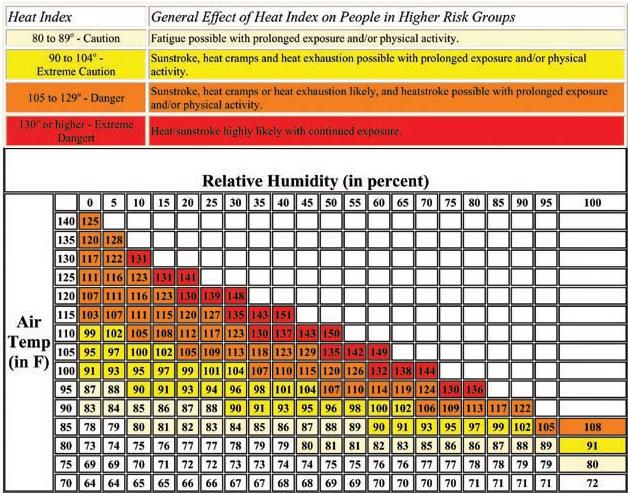
Calculate Your Heat Index

If you know your current temperature and relative humidity, you can use this table to approximate your current heat index.

HEAT - The #1 Non-Severe Weather Related Cause of Death


From NOAA: "The National Weather Service statistical data shows that heat causes more fatalities per year than floods, lightning, tornadoes and hurricanes combined. Based on the 10-year average from 2000 to 2009, excessive heat claims an average of 162 lives a year. By contrast, hurricanes killed 117; floods 65; tornadoes, 62; and lightning, 48.

In the disastrous heat wave of 1980, more than 1,250 people died. In the heat wave of 1995, more than 700 deaths in the Chicago area were attributed to heat. In August 2003, a record heat wave in Europe claimed an estimated 50,000 lives. Read more on HEAT from the National Weather Service:

Even though it'll be hot the next couple of days here in Minnesota and Wisconsin, the good news is that it won't be as hot as what folks are seeing just to the south. Take a look at all the heat related watches and warning to the south:

In these locations, heat indices have been consistently running above 100 degrees and as high as 125 degrees in Gulf Shores, Louisiana. This is dangerous heat, which can quick lead to heat exhaustion and heat stroke. Know the warning signs:

Atlantic Acting Up

Tropical Depression #4 developed in the Atlantic Basin on Monday as is forecast to become Tropical Storm COLIN early Tuesday morning. See the forecast track below:

The image below shows where August cyclones typically form and where they typically track:


Pakistan Flooding

The death toll in Pakistan due to some of the worst flooding decades now stands at 1,100 - read more from MSNBC here:


A bridge is washed away following flooding in the Swat region of Khyber-Pakhtunkhwa Province on Monday. The United Nations and the United States announced $10 million in emergency aid for Pakistan on Sunday. (Photo Courtesy: W. Khan / EPA)


Russian Wildfires

From Boston.com: "To date, over 1,500 homes have been destroyed and 40 lives have been lost. as wildfires continue across over 300,000 acres." Read more and see more pictures from Boston.com here:

(Photo Courtesy: NASA - Smoke seen via visible satellite over Russian nearly 23,000 miles above the Earth's surface)


Thursday, February 25, 2010

Climate change climbdown: scientists agree to reexamine data


CLIMATE scientists are to re-examine 150 years of global temperature records in an attempt to regain the public trust rocked by revelations about errors and withheld data.

The Met Office put forward the proposal, which was accepted, at a meeting of the World Meteorological Organization this week.

In a document entitled Proposal For A New International Analysis Of Land Surface Air Temperature Data, the Met Office said: “We feel it is timely to propose an international effort to re-analyze surface temperature data in collaboration with the World Meteorological Organization.” The new assessment would be ­independent and based on publicly available data that could be challenged by climate-change skeptics.

Met Office spokesman John Hammond said: “The assessment would bring together the best scientists from the top meteorological institutions around the world.”

And he said they would be using data collected worldwide, dating back as far as 1850.

The re-analysis is designed to support claims put out by the Inter governmental Panel On Climate Change but could overturn the widely believed theory that global warming is man-made. The World Meteorological Organization said the Met Office proposal had been approved in principle by delegates at a meeting in Turkey this week.

(Personally, I think this is a very good idea. Open the entire process up for public inspection. Shine a light on the scientific method and how "good science" is performed. This is a necessary step to regain public trust on this issue. The entire article in the UK's "Express" is here).

Tuesday, February 23, 2010

Snow job: winter weather doesn't disprove climate change


First in an occasional series.

The Claim

"It's the most severe winter storm in years, which would seem to contradict Al Gore's hysterical global warming theories." -- Sean Hannity, Fox News host

"Historic snow storm in Washington -- third this year -- where is Al Gore to explain it snows this heavily as a sign global warming is imminent." -- Newt Gingrich, former Republican Speaker of the U.S. House of Representatives

The Context

A harsh winter in Washington, D.C., has, predictably, been the source of plenty of Al Gore jokes. Many climate skeptics have held up recent snow storms as evidence that climate change is not actually happening.

The Evidence

First things first -- weather is not climate. But the likelihood of certain weather patterns is determined by climate. What we've seen in the snow-covered middle Atlantic this winter isn't just possible in a warming world, but it was actually anticipated.

Let's go straight to the U.S. Global Change Research Program's very useful synthesis report, Global Climate Change Impacts in the United States. On the subject of winter storms, it says: "There is also evidence of an increase in the intensity of storms in both the mid- and high-latitude areas of the Northern Hemisphere, with greater confidence in the increases occurring in high latitudes. The northward shift is projected to continue, and strong cold season storms are likely to become stronger and more frequent, with greater wind speeds and more extreme wave heights. " (Emphasis ours.)

(The complete article at onearth.org is here).

Antarctic ice melting supports global warming


A new study of Antarctic ice suggests that in spite all the fuss around climategate, the controversy over whether scientists have withheld facts casting doubt on the theory of global warming, there continues to be evidence that the world is heating up. The latest evidence is from the US Geological Survey, which said its research is the first to document that every ice front in the southern part of the Antarctic Peninsula has been retreating from 1947 to 2009, with the most dramatic changes occurring since 1990.

Its latest research, on the southern part of the Peninsula, is particularly alarming, according to the USGS, because that area has the Peninsula’s coolest temperatures. Because the USGS has found ice shelves are retreating in the southern section of the Antarctic Peninsula, it feels certain that global warming is affecting the entire length of the Peninsula. In the words of USGS scientist Jane Ferrigno:

This research is part of a larger ongoing USGS project that is for the first time studying the entire Antarctic coastline in detail, and this is important because the Antarctic ice sheet contains 91 per cent of earth’s glacier ice. The loss of ice shelves is evidence of the effects of global warming. We need to be alert and continually understand and observe how our climate system is changing.

The USGS says the retreating ice shelves could result in glacier retreat and sea-level rise if warming continues, threatening coastal communities and low-lying islands worldwide. It explains the importance of this:

The ice shelves are attached to the continent and aready floating, holding in place the Antarctic ice sheet that covers about 98 per cent of the Antarctic continent. As the ice shelves break off, it is easier for outlet glaciers and ice streams from the ice sheet to flow into the sea. The transition of that ice from land to the ocean is what raises sea level.

(The complete article in the Financial Times is here).

Wednesday, February 17, 2010

More IPCC Headaches: how reliable is the hurricane data?


More trouble looms for the IPCC. The body may need to revise statements made in its Fourth Assessment Report on hurricanes and global warming. A statistical analysis of the raw data shows that the claims that global hurricane activity has increased cannot be supported.

Les Hatton once fixed weather models at the Met Office. Having studied Maths at Cambridge, he completed his PhD as metereologist: his PhD was the study of tornadoes and waterspouts. He’s a fellow of the Royal Meterological Society, currently teaches at the University of Kingston, and is well known in the software engineering community – his studies include critical systems analysis.

Hatton has released what he describes as an ‘A-level’ statistical analysis, which tests six IPCC statements against raw data from the National Oceanic and Atmospheric (NOAA) Administration. He’s published all the raw data and invites criticism, but warns he is neither “a warmist nor a denialist”, but a scientist.

(The number of intense, category 3-5 hurricanes has nearly doubled since 1970, but it's difficult for climatologists to connect the dots and say that climate change is resulting in MORE hurricanes. In the end it may be that we're loading the dice, warmer ocean water increasing the potential for severe hurricanes, but making the claim that man-made warming is producing more hurricanes can't - yet - be supported by the data). The complete article is here.

Tuesday, February 16, 2010

Washington's snowstorms, brought to you by global warming


RIPTON, VERMONT -- You want to hear my winter weather story? No, really, I know you do.

The cross-country ski race I've been training for, set for today high in the Green Mountains: cancelled, lack of snow.

Meanwhile, across the continent, backhoes and helicopters are moving snow down British Columbia's Cypress Mountain in an attempt to cover the Olympic ski courses, and technicians are burying cooling pipes beneath the moguls to keep them from melting. Some climate-conscious jokers put out a video pushing the sport of "bobwheeling" for future snow-challenged Olympiads.

And apparently there was some snowfall in the greater Washington area last week.

When you're trying to launch snowboarding tricks on dry ground and simultaneously shutting down the U.S. government because the snowbanks are casting shadows on the Washington Monument, something odd is going on. This isn't a good old-fashioned winter for the District of Columbia, not unless you're remembering the last ice age. And it doesn't disprove global warming, despite Sen. Jim De Mint's cheerful tweet: "It's going to keep snowing until Al Gore cries 'uncle.' "

Instead, the weird and disruptive weather patterns around the world are pretty much exactly what you'd expect as the planet warms. Here's how it works:

The complete blog post is here.

Scientists dispute climate skeptic's claim that US weather data is useless


Some amateur climate sceptics have said weather stations across the US are poorly located and thus cannot be relied on. Photograph: Junos/Corbis


It appeared to have shaken the credibility of one of the most important global warming data sets in the world. A blog-inspired campaign by amateur climate sceptics seemed to show that numerous weather stations across the US were so poorly located they could not be relied upon.

But a new scientific analysis, using data from the sceptics, has shown that, if anything, the poorly located stations underestimate warming, rather than exaggerating it.

The US temperature record uses data from thousands of weather stations spread around the country. Their accuracy was called into question following a campaign by climate sceptic Anthony Watts, an ex-weatherman who runs the influential blog WattsUpWithThat.

He set up a site called surfacestations.org for readers to post photos of poorly located weather stations, particularly in places that could be influenced by artificial heat, such as air conditioning units or car parks. The photos were compiled into a book published by the right-wing thinktank the Heartland Institute. In it, Watts wrote: "The conclusion is inescapable: The US temperature record is unreliable. And since the US record is thought to be 'the best in the world,' it follows that the global database is likely similarly compromised and unreliable."

But scientists at the National Climatic Data Centre (NCDC) in North Carolina have analysed the weather station data to see what difference poor location actually makes. Watts had ranked the stations by his estimation of the quality of their location, so Dr Matthew Menne and colleagues compared the results from high- and low-ranked stations. They described their results as "counterintuitive" – poorly located stations were actually more likely to be cooler than those in better locations. This is probably because the poorly located stations are more likely to use more up-to-date measuring equipment called Maximum-Minimum Temperature System (MMTS), which has a slight "cool" bias that is already well documented.

The complete article in the UK's Guardian newspaper is here.

The continuing climate meltdown


It has been a bad—make that dreadful—few weeks for what used to be called the "settled science" of global warming, and especially for the U.N. Intergovernmental Panel on Climate Change that is supposed to be its gold standard.

First it turns out that the Himalayan glaciers are not going to melt anytime soon, notwithstanding dire U.N. predictions. Next came news that an IPCC claim that global warming could destroy 40% of the Amazon was based on a report by an environmental pressure group. Other IPCC sources of scholarly note have included a mountaineering magazine and a student paper.

Since the climategate email story broke in November, the standard defense is that while the scandal may have revealed some all-too-human behavior by a handful of leading climatologists, it made no difference to the underlying science. We think the science is still disputable. But there's no doubt that climategate has spurred at least some reporters to scrutinize the IPCC's headline-grabbing claims in a way they had rarely done previously.

Take the rain forest claim. In its 2007 report, the IPCC wrote that "up to 40% of the Amazonian forests could react drastically to even a slight reduction in precipitation; this means that the tropical vegetation, hydrology and climate system in South America could change very rapidly to another steady state."

But as Jonathan Leake of London's Sunday Times reported last month, those claims were based on a report from the World Wildlife Fund, which in turn had fundamentally misrepresented a study in the journal Nature. The Nature study, Mr. Leake writes, "did not assess rainfall but in fact looked at the impact on the forest of human activity such as logging and burning."

The IPCC has relied on World Wildlife Fund studies regarding the "transformation of natural coastal areas," the "destruction of more mangroves," "glacial lake outbursts causing mudflows and avalanches," changes in the ecosystem of the "Mesoamerican reef," and so on. The Wildlife Fund is a green lobby that believes in global warming, and its "research" reflects its advocacy, not the scientific method.

The rest of the editorial in the Wall Street Journal is here.

Friday, February 5, 2010

Don't confuse weather - climate


.....Studies from both hemispheres indicate that 95 percent of the world’s alpine glaciers are retreating. Glacier National Park in Montana is down to 26 named glaciers from 150 in 1850. If this trend continues, the park is expected to be ice-free by 2030. Glaciers in the Himalayas are shrinking so rapidly that the summer flow of the major rivers (Indus, Ganges, Mekong, Yellow, Yangtze) they feed may eventually be seriously affected.

Permafrost regions are thawing in high northern latitudes, causing buildings to sink, roads to crumble, and a variety of other troubles for human infrastructure. The great ice sheets are retreating. The Greenland ice sheet melting began to accelerate in the 1990s. Now the margin of the entire ice mass is melting even in its northernmost reaches. The West Antarctic ice sheet has begun extensive melting, mostly since 2000, and the rate of melting has increased since then.

Sea level is rising, and the rate of rise has accelerated over the last century. A tide gauge on a concrete, open-ocean pier in Duck, N.C., indicates the sea level is now rising at a 1 1/2-foot-per-century rate. In the Pacific, atoll nations such as Tuvalu already are being abandoned because of the rising sea. Soon the Maldives must follow.

The summer sea-ice cover of the Arctic Ocean is shrinking and thinning, and may disappear altogether.

So, one can argue for hours regarding whether this year was warmer or colder than last. It really doesn’t matter. We should be reading the planet, not thermometers. The Earth is clearly warming and sea level is clearly rising....

The complete article in the Atlanta Journal Constitution is here.

Sunday, January 31, 2010

Is global warming a crock of s&%! ?


We are being warned and exhorted that, unless serious measures are taken to reverse our contributions to greenhouse gases, humans have put the planet on an unsustainable course for potential crises up to extinction. The irony is that, on the news, there is little agreement on what's caused massive shifts in temperatures over the past millennium.

"Global warming is a crock of s*%t!" When Bob Lutz, vice-chairman of General Motors, said this in February 2008, it immediately became the most widely distributed quote regarding global warming on the Internet. After all, this was one of the major power players in the automobile industry, and he was implying that anyone who believed that global warming was real, man-made, and altering the planet was something akin to a moron. But the problem with that quote is that it's incomplete. I know. I was there.

It was at a small private luncheon at Cacharel in Arlington, Tex., when Lutz uttered those words. But the quote omits what he said next: "Don't misunderstand me, I'm not a climate denier." As he explained to those present, he simply questions the mindset that blames all the climate change of the past few decades on mankind.

Lutz's comments that day were far more balanced and thoughtful than anyone who heard that particular quote might believe. And therein lies the problem with the current discussions on global warming: The media have taken the position that the science is complete and settled. A unanimous agreement that global warming not only exists but is man-made -- and we're almost past the point where we can still save the planet from it. Moreover, anyone who questions those absolute statements is quickly labeled a "Climate Change Denier." This label is intended to shame and discredit doubters, much like 500 years ago when church officials prosecuted anyone who preached the earth was not the center of the universe.

However, labeling to discredit someone by calling them a "denier" is a distorted and completely unjust position to take on such an important subject. In fact, virtually no one believes the earth has not gone through a period of unexplained warming. Therefore, the term "denier" is not just inaccurate, it's a complete and intentional mis-characterization of those wanting more open and honest scientific studies on the subject.

For the complete article in Sci-Tech-Today click here.

Radio operators are the eyes of the National Weather Service


Even in the age of high-powered Doppler radar, instant communications and the Internet, the National Weather Service and local safety officials still rely heavily on old methods for accurate observations and emergency communications.

Volunteer amateur — or ham — radio operators still play a primary role in providing on-site information about tornadoes and storm conditions to weather forecasters and letting emergency responders know what’s going on.

"There’s nothing like ground troops," said Keith Wells, assistant coordinator with the Tarrant County Office of Emergency Management, who was helping the National Weather Service on Saturday at the annual Skywarn storm spotter training session at Texas Christian University.

"One of the most important things we do all year is train the spotters," Wells said. "When you have a trained observer on the ground at Bryant Irvin Road reporting golf-ball-sized hail or a funnel cloud, that really tells a meteorologist what’s going on."

More than 400 people showed up for the training, most already members of Tarrant County RACES (Radio Amateurs in Civil Emergency Service). The volunteers are willing to fire up their radios and vehicles and often head out looking for storm action to provide instant observations to the weather service.

It’s a service that amateur radio operators have provided locally since the early 1970s.

The Fort Worth Star-Telegraph has the complete article here.

Pentagon review to address climate change for the first time


The Pentagon is addressing climate change for the first time in its sweeping review of military strategy.

The Pentagon is set to release the Quadrennial Defense Review (QDR) on Monday, along with the 2011 budget request.

In the review, Pentagon officials conclude that climate change will act as an “accelerant of instability and conflict,” ultimately placing a burden on civilian institutions and militaries around the world.

Senate Foreign Relations Committee Chairman John Kerry (D-Mass.), a key architect of Senate climate plans, was the first to draw attention to the significance of climate change in the QDR. Kerry said last week that the QDR will list climate change as a security problem that could claim U.S. lives.

“I will tell you that the defense review of the United States Pentagon next week is going to come out and list climate change for the first time as an instability factor that affects our troops and may in fact wind up costing us lives down the road,” Kerry said at a forum hosted by labor, business, veteran and other groups backing climate legislation.

The complete article in the "The Hill" publication is here.

Why has global warming paused? Water vapor may be the answer


A decline in stratospheric water vapor between 2000 and 2009 followed an apparent increase between 1980 and 2000, a team of scientists has found. That finding may have implications for global warming.


A decade-long plateau in global warming appears to have occurred in large part because the stratosphere – the layer of atmosphere that few but airliners enter – got drier.

That’s an explanation by a team of atmospheric scientists from the United States and Germany. They’ve studied trends in stratospheric water vapor over the past 30 years and calculated the effects of those trends on temperatures.

A decline in stratospheric water vapor between 2000 and 2009 followed an apparent increase between 1980 and 2000, according to balloon and satellite measurements that the team used. The decline slowed the long-term growth in global average temperatures by some 25 percent, compared with the warming one could expect from rising concentrations of greenhouse gases alone, the team estimates.

"There's not a lot of water in the stratosphere. It's extremely dry," says Susan Solomon, an atmospheric scientist at the National Oceanic and Atmospheric Administration's Earth System Research Laboratory in Boulder, Colo., who led the team. "But it packs a wallop" in terms of its climatic effects, she says.

Other factors probably played a role as well in the temperature plateau, the team acknowledges.

Another contributor could have been sulfate aerosols from the rising number of coal-fired power plants in China, point out researchers such as Drew Shindell, with the National Aeronautics and Space Administration’s Goddard Institute for Space Studies (GISS) in New York.

The complete article in the Christian Science Monitor is here.

Climate change blamed for Olympic snow shortage

More mud than snow for the '10 Winter Olympics in Vancouver?

The David Suzuki Foundation says global warming and climate change are in part responsible for what's happening to a key Olympic venue.

Olympic organizers are working around the clock to ensure there's enough snow on Cypress Mountain, home to freestyle ski and snowboard events for the Games.

Record warm temperatures and heavy rains this winter have forced VANOC to use bales of hay and to truck in snow to create the courses for the events.

The Games are a perfect catalyst for Canada to take climate change seriously in the long term, according to Ian Bruce, the lead climate change campaigner at the Suzuki Foundation.

"It's crucial, as far as our economy goes here in Canada [and] it's crucial to protect winter sports as far as our culture goes," Bruce said.

Monday, January 25, 2010

Scientists "losing climate fight"


A leading Australian climate change scientist says experts are losing the fight against skeptics, who are distorting the science of global warming.

His comments come as a prominent British climate change skeptic tours the country.

Lord Christopher Monckton has arrived in Australia for a series of lectures and is calling for a royal commission into the science around global warming.

The former journalist and political adviser to Margaret Thatcher says the production of carbon dioxide is not a major problem.

He has attacked the United Nations Intergovernmental Panel on Climate Change (IPCC) after it revised a key finding in its 2007 report which wrongly claimed the Himalayan glaciers would melt by 2035.

But one of the lead authors of the report, Australian Professor Andy Pitman, has defended the overall conclusions of the report.

Professor Pitman was a lead author on the IPCC's 2001 and 2007 reports. He is also the co-director of the Climate Change Research Centre at the University of New South Wales.

Professor Pitman says sceptics have used the IPCC's error to skew the climate change debate.

"Climate scientists are losing the fight with the skeptics," he said.

"The sceptics are so well funded, so well organised. "They have nothing else to do. They don't have day jobs so they can put all their efforts into misinforming and mis-communicating climate science to the general public, whereas the climate scientists have day jobs and [managing publicity] actually isn't one of them.

"All of the efforts you do in an IPCC report is done out of hours, voluntarily, for no funding and no pay, whereas the skeptics are being funded to put out full-scale misinformation campaigns and are doing a damn good job, I think.

The rest of the post is here.

"Global warming is a proven fact"


CHICAGO — More than 40 scientists with expertise in climate, agriculture, soil and entomological science have sent a letter to American Farm Bureau Federation President Bob Stallman requesting a meeting to discuss his group’s “inaccurate and marginalized” position on global warming. The Farm Bureau maintains that “there is no generally agreed upon scientific assessment on carbon emissions from human activities, their impact on past decades of warming or how they will affect future climate changes.” According to the scientists’ letter, that assertion ignores the overwhelming scientific evidence of climate change, a problem that puts Farm Bureau members at risk. “As scientists concerned about the grave risks that climate change poses to the world and U.S. agriculture,” the letter states, “we are disappointed that the American Farm Bureau has chosen to officially deny the existence of human-caused climate change when the evidence of it has never been clearer.”

The entire article in agweek.com is here.

Warming expected to cut Atlantic hurricane tally, but boost threat


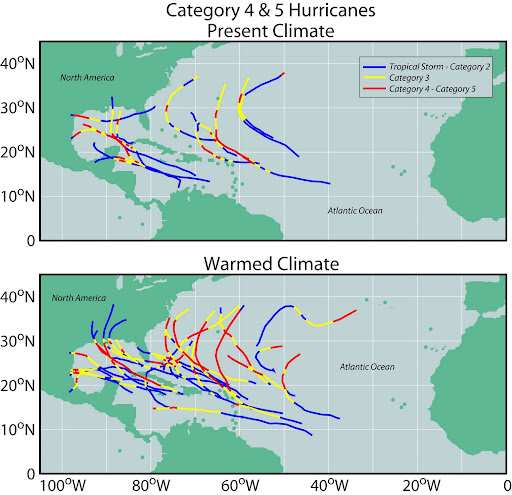
A new modeling study published in this week’s issue of Science projects a rise of about 30 percent in potential hurricane damage in the western Atlantic toward the end of the century as emissions of greenhouse gases rise. Although the overall number of storms in the region are expected to drop, the number of strong ones — those reaching Category 4 or 5 in the hurricane index — are expected to double from the number produced now, the study says. The projections are based on a midrange scenario for a rise in the heat-trapping emissions linked to global warming.

The two maps below, produced for the study by the Geophysical Fluid Dynamics Laboratory at Princeton, are based on a climate model comparing the production of strong hurricanes in conditions mimicking the current climate (basically, average climate conditions from 1980 to 2006) with hurricane production in conditions simulating those projected for the final two decades of the century.

It’s still early days in the effort to understand how hurricanes, which thrive or fade depending on local conditions, will fare in a globally warmed world. But the modeling exercise hints at factors that do seem to make the biggest difference. “What’s really important for Atlantic hurricane activity, what really gets things cranked up, is when the Atlantic warms relative to the rest of the tropics,” said Thomas Knutson, one of the paper’s authors and a climate researcher at the Geophysical Fluid Dynamics Laboratory. He said that is what has happened in the real world since 1980, as scientists witnessed a big rise in hurricanes’ energy.

The rest of the New York Times blog article is here.

Evidence for climate change caused by man mounts


One degree Fahrenheit might not sound like a lot, but picture the amount of energy required to raise the temperature of a cup of water that amount. Multiply that for a swimming pool. Do so again for a planet, say Earth.

For biology and environmental studies professor Dan Perlman of Brandeis University in Waltham, that's the import of a new report citing the past decade as the globe's warmest on record, by nearly one degree.

"That, along with all the other evidence, continues to support the idea that we're in store for something really big here," Perlman said this past week, citing his belief that man-made emissions are artificially warming the Earth. "It's like it's another few bricks in our certainty."

The report, issued Tuesday by the National Climatic Data Center, found that the decade 2000 to 2009 had the highest average temperature dating back to the start of record-keeping in 1880. The decade was 0.96 degree warmer than the 129-year average, breaking the record of 0.56 degree warmer set by the '90s and continuing a trend from the '60s.

Also, while 0.96 degree represents a significant amount of energy, Perlman said, that number is an average for the globe, with some places staying flat or cooling and others, like the polar north, spiking.

"There are some places that are really getting hammered," he said.

Scientists like Perlman and many others attribute most of the warming since the mid-20th century to human activities such as the release of carbon dioxide and other heat-trapping gases into the atmosphere through fossil fuel burning. They say the evidence and causal relationships are well-established.

"How certain do you want to be?" asked Larry McKenna, a professor in Framingham State College's department of physics and earth sciences. "We're getting up to the 99 percent level."

The rest of the article is here.

Saturday, January 23, 2010

NASA gives global warming theory a boost

It's one of the most controversial subjects on earth, but if data from NASA

is to be believed, the past decade on the planet has been the warmest ever.

Well, when NASA says ever, that's since records began in 1880 - it has been very very hot at other periods in the earth's history. The earth was molten once, scientists think.

The survey, conducted by the Goddard Institute for Space Studies (GISS) that 2009 was the warmest year since records began. 2008 was the coolest year of the decade.

James Hansen, who has come under attack from those who dispute global warmings exist, said: "There's substantial year-to-year variabilty of global temperature cause by the tropical El Niño-La Niña cycle. But when we average temperature over five or ten years to minimize that variability, we find that global warming is continuing unabated."

The last three decades, according to GISS data, show that the surface temperature is heating up by 0.36F per decade. GISS says that this means there's a clear warming trend, although things didn't show the same trend between the 1940s and the 1970s.


The rest of the article is here.

The New York Times has an article on the warm decade here.

Thursday, January 21, 2010

Military considers global warming threat


The hand-wringing over global warming is often done by scientists and preservationists, but on Tuesday several high-ranking current and former military men visited Atlanta and talked about the possible consequences for U.S. security.

They imagine disruptions in the supply of food and water that lead to unrest and to conflict around the globe. They see poverty-stricken countries becoming increasingly unstable. And they worry about whole populations on the move, as the seas rise and rivers change their courses.

Rear Admiral David Titley said there is strong evidence that old arctic ice has melted much faster than new ice can replace it. It's a trend that scientists predict could someday yield a rise in sea level by a meter or two, he said.

"I've had people ask me: ‘Why should the Navy care?'" he said. He has a dry response loaded with sarcasm: "Well, we tend to build our bases at sea level."

(The complete article in the Atlanta Journal-Constitution is here).