Tuesday, February 16, 2010

Scientists dispute climate skeptic's claim that US weather data is useless


Some amateur climate sceptics have said weather stations across the US are poorly located and thus cannot be relied on. Photograph: Junos/Corbis


It appeared to have shaken the credibility of one of the most important global warming data sets in the world. A blog-inspired campaign by amateur climate sceptics seemed to show that numerous weather stations across the US were so poorly located they could not be relied upon.

But a new scientific analysis, using data from the sceptics, has shown that, if anything, the poorly located stations underestimate warming, rather than exaggerating it.

The US temperature record uses data from thousands of weather stations spread around the country. Their accuracy was called into question following a campaign by climate sceptic Anthony Watts, an ex-weatherman who runs the influential blog WattsUpWithThat.

He set up a site called surfacestations.org for readers to post photos of poorly located weather stations, particularly in places that could be influenced by artificial heat, such as air conditioning units or car parks. The photos were compiled into a book published by the right-wing thinktank the Heartland Institute. In it, Watts wrote: "The conclusion is inescapable: The US temperature record is unreliable. And since the US record is thought to be 'the best in the world,' it follows that the global database is likely similarly compromised and unreliable."

But scientists at the National Climatic Data Centre (NCDC) in North Carolina have analysed the weather station data to see what difference poor location actually makes. Watts had ranked the stations by his estimation of the quality of their location, so Dr Matthew Menne and colleagues compared the results from high- and low-ranked stations. They described their results as "counterintuitive" – poorly located stations were actually more likely to be cooler than those in better locations. This is probably because the poorly located stations are more likely to use more up-to-date measuring equipment called Maximum-Minimum Temperature System (MMTS), which has a slight "cool" bias that is already well documented.

The complete article in the UK's Guardian newspaper is here.

The continuing climate meltdown


It has been a bad—make that dreadful—few weeks for what used to be called the "settled science" of global warming, and especially for the U.N. Intergovernmental Panel on Climate Change that is supposed to be its gold standard.

First it turns out that the Himalayan glaciers are not going to melt anytime soon, notwithstanding dire U.N. predictions. Next came news that an IPCC claim that global warming could destroy 40% of the Amazon was based on a report by an environmental pressure group. Other IPCC sources of scholarly note have included a mountaineering magazine and a student paper.

Since the climategate email story broke in November, the standard defense is that while the scandal may have revealed some all-too-human behavior by a handful of leading climatologists, it made no difference to the underlying science. We think the science is still disputable. But there's no doubt that climategate has spurred at least some reporters to scrutinize the IPCC's headline-grabbing claims in a way they had rarely done previously.

Take the rain forest claim. In its 2007 report, the IPCC wrote that "up to 40% of the Amazonian forests could react drastically to even a slight reduction in precipitation; this means that the tropical vegetation, hydrology and climate system in South America could change very rapidly to another steady state."

But as Jonathan Leake of London's Sunday Times reported last month, those claims were based on a report from the World Wildlife Fund, which in turn had fundamentally misrepresented a study in the journal Nature. The Nature study, Mr. Leake writes, "did not assess rainfall but in fact looked at the impact on the forest of human activity such as logging and burning."

The IPCC has relied on World Wildlife Fund studies regarding the "transformation of natural coastal areas," the "destruction of more mangroves," "glacial lake outbursts causing mudflows and avalanches," changes in the ecosystem of the "Mesoamerican reef," and so on. The Wildlife Fund is a green lobby that believes in global warming, and its "research" reflects its advocacy, not the scientific method.

The rest of the editorial in the Wall Street Journal is here.

Friday, February 5, 2010

Don't confuse weather - climate


.....Studies from both hemispheres indicate that 95 percent of the world’s alpine glaciers are retreating. Glacier National Park in Montana is down to 26 named glaciers from 150 in 1850. If this trend continues, the park is expected to be ice-free by 2030. Glaciers in the Himalayas are shrinking so rapidly that the summer flow of the major rivers (Indus, Ganges, Mekong, Yellow, Yangtze) they feed may eventually be seriously affected.

Permafrost regions are thawing in high northern latitudes, causing buildings to sink, roads to crumble, and a variety of other troubles for human infrastructure. The great ice sheets are retreating. The Greenland ice sheet melting began to accelerate in the 1990s. Now the margin of the entire ice mass is melting even in its northernmost reaches. The West Antarctic ice sheet has begun extensive melting, mostly since 2000, and the rate of melting has increased since then.

Sea level is rising, and the rate of rise has accelerated over the last century. A tide gauge on a concrete, open-ocean pier in Duck, N.C., indicates the sea level is now rising at a 1 1/2-foot-per-century rate. In the Pacific, atoll nations such as Tuvalu already are being abandoned because of the rising sea. Soon the Maldives must follow.

The summer sea-ice cover of the Arctic Ocean is shrinking and thinning, and may disappear altogether.

So, one can argue for hours regarding whether this year was warmer or colder than last. It really doesn’t matter. We should be reading the planet, not thermometers. The Earth is clearly warming and sea level is clearly rising....

The complete article in the Atlanta Journal Constitution is here.

Sunday, January 31, 2010

Is global warming a crock of s&%! ?


We are being warned and exhorted that, unless serious measures are taken to reverse our contributions to greenhouse gases, humans have put the planet on an unsustainable course for potential crises up to extinction. The irony is that, on the news, there is little agreement on what's caused massive shifts in temperatures over the past millennium.

"Global warming is a crock of s*%t!" When Bob Lutz, vice-chairman of General Motors, said this in February 2008, it immediately became the most widely distributed quote regarding global warming on the Internet. After all, this was one of the major power players in the automobile industry, and he was implying that anyone who believed that global warming was real, man-made, and altering the planet was something akin to a moron. But the problem with that quote is that it's incomplete. I know. I was there.

It was at a small private luncheon at Cacharel in Arlington, Tex., when Lutz uttered those words. But the quote omits what he said next: "Don't misunderstand me, I'm not a climate denier." As he explained to those present, he simply questions the mindset that blames all the climate change of the past few decades on mankind.

Lutz's comments that day were far more balanced and thoughtful than anyone who heard that particular quote might believe. And therein lies the problem with the current discussions on global warming: The media have taken the position that the science is complete and settled. A unanimous agreement that global warming not only exists but is man-made -- and we're almost past the point where we can still save the planet from it. Moreover, anyone who questions those absolute statements is quickly labeled a "Climate Change Denier." This label is intended to shame and discredit doubters, much like 500 years ago when church officials prosecuted anyone who preached the earth was not the center of the universe.

However, labeling to discredit someone by calling them a "denier" is a distorted and completely unjust position to take on such an important subject. In fact, virtually no one believes the earth has not gone through a period of unexplained warming. Therefore, the term "denier" is not just inaccurate, it's a complete and intentional mis-characterization of those wanting more open and honest scientific studies on the subject.

For the complete article in Sci-Tech-Today click here.

Radio operators are the eyes of the National Weather Service


Even in the age of high-powered Doppler radar, instant communications and the Internet, the National Weather Service and local safety officials still rely heavily on old methods for accurate observations and emergency communications.

Volunteer amateur — or ham — radio operators still play a primary role in providing on-site information about tornadoes and storm conditions to weather forecasters and letting emergency responders know what’s going on.

"There’s nothing like ground troops," said Keith Wells, assistant coordinator with the Tarrant County Office of Emergency Management, who was helping the National Weather Service on Saturday at the annual Skywarn storm spotter training session at Texas Christian University.

"One of the most important things we do all year is train the spotters," Wells said. "When you have a trained observer on the ground at Bryant Irvin Road reporting golf-ball-sized hail or a funnel cloud, that really tells a meteorologist what’s going on."

More than 400 people showed up for the training, most already members of Tarrant County RACES (Radio Amateurs in Civil Emergency Service). The volunteers are willing to fire up their radios and vehicles and often head out looking for storm action to provide instant observations to the weather service.

It’s a service that amateur radio operators have provided locally since the early 1970s.

The Fort Worth Star-Telegraph has the complete article here.

Pentagon review to address climate change for the first time


The Pentagon is addressing climate change for the first time in its sweeping review of military strategy.

The Pentagon is set to release the Quadrennial Defense Review (QDR) on Monday, along with the 2011 budget request.

In the review, Pentagon officials conclude that climate change will act as an “accelerant of instability and conflict,” ultimately placing a burden on civilian institutions and militaries around the world.

Senate Foreign Relations Committee Chairman John Kerry (D-Mass.), a key architect of Senate climate plans, was the first to draw attention to the significance of climate change in the QDR. Kerry said last week that the QDR will list climate change as a security problem that could claim U.S. lives.

“I will tell you that the defense review of the United States Pentagon next week is going to come out and list climate change for the first time as an instability factor that affects our troops and may in fact wind up costing us lives down the road,” Kerry said at a forum hosted by labor, business, veteran and other groups backing climate legislation.

The complete article in the "The Hill" publication is here.

Why has global warming paused? Water vapor may be the answer


A decline in stratospheric water vapor between 2000 and 2009 followed an apparent increase between 1980 and 2000, a team of scientists has found. That finding may have implications for global warming.


A decade-long plateau in global warming appears to have occurred in large part because the stratosphere – the layer of atmosphere that few but airliners enter – got drier.

That’s an explanation by a team of atmospheric scientists from the United States and Germany. They’ve studied trends in stratospheric water vapor over the past 30 years and calculated the effects of those trends on temperatures.

A decline in stratospheric water vapor between 2000 and 2009 followed an apparent increase between 1980 and 2000, according to balloon and satellite measurements that the team used. The decline slowed the long-term growth in global average temperatures by some 25 percent, compared with the warming one could expect from rising concentrations of greenhouse gases alone, the team estimates.

"There's not a lot of water in the stratosphere. It's extremely dry," says Susan Solomon, an atmospheric scientist at the National Oceanic and Atmospheric Administration's Earth System Research Laboratory in Boulder, Colo., who led the team. "But it packs a wallop" in terms of its climatic effects, she says.

Other factors probably played a role as well in the temperature plateau, the team acknowledges.

Another contributor could have been sulfate aerosols from the rising number of coal-fired power plants in China, point out researchers such as Drew Shindell, with the National Aeronautics and Space Administration’s Goddard Institute for Space Studies (GISS) in New York.

The complete article in the Christian Science Monitor is here.

Climate change blamed for Olympic snow shortage

More mud than snow for the '10 Winter Olympics in Vancouver?

The David Suzuki Foundation says global warming and climate change are in part responsible for what's happening to a key Olympic venue.

Olympic organizers are working around the clock to ensure there's enough snow on Cypress Mountain, home to freestyle ski and snowboard events for the Games.

Record warm temperatures and heavy rains this winter have forced VANOC to use bales of hay and to truck in snow to create the courses for the events.

The Games are a perfect catalyst for Canada to take climate change seriously in the long term, according to Ian Bruce, the lead climate change campaigner at the Suzuki Foundation.

"It's crucial, as far as our economy goes here in Canada [and] it's crucial to protect winter sports as far as our culture goes," Bruce said.

Monday, January 25, 2010

Scientists "losing climate fight"


A leading Australian climate change scientist says experts are losing the fight against skeptics, who are distorting the science of global warming.

His comments come as a prominent British climate change skeptic tours the country.

Lord Christopher Monckton has arrived in Australia for a series of lectures and is calling for a royal commission into the science around global warming.

The former journalist and political adviser to Margaret Thatcher says the production of carbon dioxide is not a major problem.

He has attacked the United Nations Intergovernmental Panel on Climate Change (IPCC) after it revised a key finding in its 2007 report which wrongly claimed the Himalayan glaciers would melt by 2035.

But one of the lead authors of the report, Australian Professor Andy Pitman, has defended the overall conclusions of the report.

Professor Pitman was a lead author on the IPCC's 2001 and 2007 reports. He is also the co-director of the Climate Change Research Centre at the University of New South Wales.

Professor Pitman says sceptics have used the IPCC's error to skew the climate change debate.

"Climate scientists are losing the fight with the skeptics," he said.

"The sceptics are so well funded, so well organised. "They have nothing else to do. They don't have day jobs so they can put all their efforts into misinforming and mis-communicating climate science to the general public, whereas the climate scientists have day jobs and [managing publicity] actually isn't one of them.

"All of the efforts you do in an IPCC report is done out of hours, voluntarily, for no funding and no pay, whereas the skeptics are being funded to put out full-scale misinformation campaigns and are doing a damn good job, I think.

The rest of the post is here.

"Global warming is a proven fact"


CHICAGO — More than 40 scientists with expertise in climate, agriculture, soil and entomological science have sent a letter to American Farm Bureau Federation President Bob Stallman requesting a meeting to discuss his group’s “inaccurate and marginalized” position on global warming. The Farm Bureau maintains that “there is no generally agreed upon scientific assessment on carbon emissions from human activities, their impact on past decades of warming or how they will affect future climate changes.” According to the scientists’ letter, that assertion ignores the overwhelming scientific evidence of climate change, a problem that puts Farm Bureau members at risk. “As scientists concerned about the grave risks that climate change poses to the world and U.S. agriculture,” the letter states, “we are disappointed that the American Farm Bureau has chosen to officially deny the existence of human-caused climate change when the evidence of it has never been clearer.”

The entire article in agweek.com is here.

Warming expected to cut Atlantic hurricane tally, but boost threat


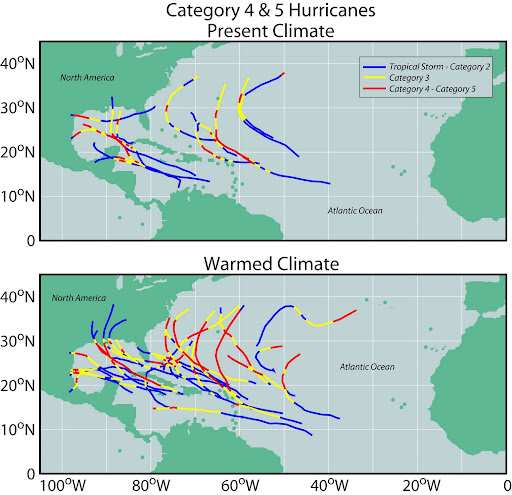
A new modeling study published in this week’s issue of Science projects a rise of about 30 percent in potential hurricane damage in the western Atlantic toward the end of the century as emissions of greenhouse gases rise. Although the overall number of storms in the region are expected to drop, the number of strong ones — those reaching Category 4 or 5 in the hurricane index — are expected to double from the number produced now, the study says. The projections are based on a midrange scenario for a rise in the heat-trapping emissions linked to global warming.

The two maps below, produced for the study by the Geophysical Fluid Dynamics Laboratory at Princeton, are based on a climate model comparing the production of strong hurricanes in conditions mimicking the current climate (basically, average climate conditions from 1980 to 2006) with hurricane production in conditions simulating those projected for the final two decades of the century.

It’s still early days in the effort to understand how hurricanes, which thrive or fade depending on local conditions, will fare in a globally warmed world. But the modeling exercise hints at factors that do seem to make the biggest difference. “What’s really important for Atlantic hurricane activity, what really gets things cranked up, is when the Atlantic warms relative to the rest of the tropics,” said Thomas Knutson, one of the paper’s authors and a climate researcher at the Geophysical Fluid Dynamics Laboratory. He said that is what has happened in the real world since 1980, as scientists witnessed a big rise in hurricanes’ energy.

The rest of the New York Times blog article is here.

Evidence for climate change caused by man mounts


One degree Fahrenheit might not sound like a lot, but picture the amount of energy required to raise the temperature of a cup of water that amount. Multiply that for a swimming pool. Do so again for a planet, say Earth.

For biology and environmental studies professor Dan Perlman of Brandeis University in Waltham, that's the import of a new report citing the past decade as the globe's warmest on record, by nearly one degree.

"That, along with all the other evidence, continues to support the idea that we're in store for something really big here," Perlman said this past week, citing his belief that man-made emissions are artificially warming the Earth. "It's like it's another few bricks in our certainty."

The report, issued Tuesday by the National Climatic Data Center, found that the decade 2000 to 2009 had the highest average temperature dating back to the start of record-keeping in 1880. The decade was 0.96 degree warmer than the 129-year average, breaking the record of 0.56 degree warmer set by the '90s and continuing a trend from the '60s.

Also, while 0.96 degree represents a significant amount of energy, Perlman said, that number is an average for the globe, with some places staying flat or cooling and others, like the polar north, spiking.

"There are some places that are really getting hammered," he said.

Scientists like Perlman and many others attribute most of the warming since the mid-20th century to human activities such as the release of carbon dioxide and other heat-trapping gases into the atmosphere through fossil fuel burning. They say the evidence and causal relationships are well-established.

"How certain do you want to be?" asked Larry McKenna, a professor in Framingham State College's department of physics and earth sciences. "We're getting up to the 99 percent level."

The rest of the article is here.

Saturday, January 23, 2010

NASA gives global warming theory a boost

It's one of the most controversial subjects on earth, but if data from NASA

is to be believed, the past decade on the planet has been the warmest ever.

Well, when NASA says ever, that's since records began in 1880 - it has been very very hot at other periods in the earth's history. The earth was molten once, scientists think.

The survey, conducted by the Goddard Institute for Space Studies (GISS) that 2009 was the warmest year since records began. 2008 was the coolest year of the decade.

James Hansen, who has come under attack from those who dispute global warmings exist, said: "There's substantial year-to-year variabilty of global temperature cause by the tropical El Niño-La Niña cycle. But when we average temperature over five or ten years to minimize that variability, we find that global warming is continuing unabated."

The last three decades, according to GISS data, show that the surface temperature is heating up by 0.36F per decade. GISS says that this means there's a clear warming trend, although things didn't show the same trend between the 1940s and the 1970s.


The rest of the article is here.

The New York Times has an article on the warm decade here.

Thursday, January 21, 2010

Military considers global warming threat


The hand-wringing over global warming is often done by scientists and preservationists, but on Tuesday several high-ranking current and former military men visited Atlanta and talked about the possible consequences for U.S. security.

They imagine disruptions in the supply of food and water that lead to unrest and to conflict around the globe. They see poverty-stricken countries becoming increasingly unstable. And they worry about whole populations on the move, as the seas rise and rivers change their courses.

Rear Admiral David Titley said there is strong evidence that old arctic ice has melted much faster than new ice can replace it. It's a trend that scientists predict could someday yield a rise in sea level by a meter or two, he said.

"I've had people ask me: ‘Why should the Navy care?'" he said. He has a dry response loaded with sarcasm: "Well, we tend to build our bases at sea level."

(The complete article in the Atlanta Journal-Constitution is here).

Monday, January 18, 2010

Nobel-winning panel's warning on glaciers discredited


A much-publicized United Nation panel’s estimate about the rapid melting of Himalayan glaciers from climate change is coming under fire as a gross exaggeration.

The United Nations Intergovernmental Panel on Climate Change had said in 2007, the same year it won the Nobel Prize, that it was “very likely” that Himalayan glaciers would disappear by 2030 if current warming trends continue.

That date has been much quoted and a cause for enormous consternation, since hundreds of millions of people in Asia rely on ice and snow melt from these glaciers for their water.

The panel is the United Nations’ scientific advisory body on climate change and it ranks its conclusions according to a probability scale in which “very likely” means there is greater than 90 percent chance that an event will occur.

But it now appears that the estimate about Himalayan glacial melt was based on a nearly decade-old interview of one climate scientist in a science magazine, The New Scientist, and that hard scientific evidence to support that figure is lacking. The scientist, Dr. Syed Hasnain, a glacier specialist with the government of Sikkim and currently a fellow at the TERI research institute in Delhi, studies “index glaciers” and has more recently suggested that only small glaciers would disappear entirely.

The panel is considering whether to amend the estimate or remove it. “We are investigating this issue and our members have been asked for further input,” said Brenda Abrar, a spokeswoman. The panel’s reports are exhaustive compilations of climate science created through the efforts of hundreds of scientists, and no one person can make the change.

The complete article in the NY Times is here.

Sunday, January 17, 2010

Good news for the world; bad news for the IPCC


It’s the best news of the decade so far, but not for the Intergovernmental Panel on Climate Change (IPCC), the official ultimate authority on climate science, for it poses a much greater threat to its credibility than the much-hyped “Climategate” emails and puts further questionmarks over its embattled chairman, Dr Rajendra Pachauri.

Reports today suggest that the IPCC may soon retract one of the more alarming predictions in its latest massive review of climate science, that the glaciers of the Himalayas are very likely to disappear by 2035, after it was found to be unjustified. That is emphatically good news for the world. At least three quarters of a million people in the most populous part of the planet depend on the glaciers for water: their rapid disappearance would be an unimaginable catastrophe.

Leading glaciologist Prof Graham Cogley of Ontario’s Trent University – who says that, at current rates, the melting might take ten times longer – has been worried for some time about the prediction. At one stage he thought IPCC had wrongly transposed two figures in the date from a 1996 scientific paper that forecast the glaciers’ disappearance by 2350. But the truth is even more embarrassing. It goes back to a story published in New Scientist in 1999 by its excellent environment specialist, Fred Pearce, which reported an Indian glaciologist Syed Husnain as saying they could be gone by 2035. This was mentioned six years later in a campaigning document by the environment group, WWF, and the IPCC then picked it up.

This is serious, as the authority of the IPCC rests on meticulously basing its reports on peer-reviewed literature and, indeed, on taking a conservative view. Traditionally it has erred on the side of caution, sometimes excessively so. In the same report, for example, it grossly underestimated future sea-level rise, by excluding contributions form melting ice from the Greenland and Antarctic ice-sheets, though these would be major factors: last December a highly authoritative report suggested that its forecast level should be doubled.

(Potentially embarrassing news for the IPCC, which should have got this - glaring - error, but good news for people living in Asia - the rate of melting of the glaciers in the Himalayas seems to be considerably less than anticipated in the latest IPCC prediction - ultimately giving the world more time to do something about it). The rest of the article is here.

Saturday, January 16, 2010

Rising sea level bringing change to coastal life


WEST LONG BRANCH — Think it's tough to operate a business or invest in real estate in this economy? Just wait until that sea level comes up a few more inches.

Climate change is already forcing subtle adjustments in how people live along the coast, from insurance costs to community planning, according to speakers at a panel on climate-change effects at the Shore, hosted today by Monmouth University's Urban Coast Institute and co-sponsored by the Jersey Shore Partnership and Monmouth-Ocean Development Council.

"Adaptation is already well under way," said Radley Horton, a scientist with Columbia University's Center for Climate System Research and an adviser to New York City's climate change committee.

City planners are looking to protect critical infrastructure from sea-level rise, conservatively projected at 1 to 2 feet in this century, he said.

Even if storms don't increase in strength and frequency, that sea-level rise will mean that today's storm floods of about 8 feet above mean low water will occur five times as frequently, Horton told the gathering in Wilson Hall.

(looking for a solid, long-term investment? Think dikes & levees, technology similar to what the Netherlands tap to keep the North Sea out of their - reclaimed - yards and towns. I'm serious. A slow-motion rise in sea level is underway; this becomes much more critical during hurricanes and even nor'easters that roar up the east coast. It may not seem like much, but even a rise of a few inches makes a significant difference in ultimate damage when storm-induced waves are superimposed on this rise in sea level).

The rest of the article is here.

Meteorologists as climate change deniers?


A recent piece in the Columbia Journalism Review (http://www.cjr.org/cover_story/hot_air.php) examined the rise in global warming denial among the ranks of TV meteorologists.

It's not just that the climate change deniers (as clunky a label as you'll find) claim that the climate scientists got it wrong; it's not that there was a mistake somewhere, some statistician forgot to carry a two in an important calculation or neglected to convert feet to meters.

No, the accusation is more venomous than that: Human-caused global warming is not an error, it is a hoax. It is an intentional fraud, a worldwide conspiracy.As San Diego weatherman John Coleman wrote in a November 2007 opinion piece, "Global Warming is a nonevent, a manufactured crisis and a total scam." The climate scientists are liars and con men who have no qualms about faking data if it will help assure them funding and continued research grants. It's all about the money. (By this logic, doctors are secretly doing their best to make the public sick, thus ensuring a continued supply of patients and income.)

Curiously, Coleman is not alone; according to a survey conducted by an Emory University researcher, nearly one-third (29 percent) of the television meteorologists he asked responded that global warming was a "scam." That percentage may or many not be representative of all local TV station forecasters nationwide, but it should be cause for alarm.

Coleman's article, which has been widely disseminated and used by critics of global warming, reflects a curious anti-science, anti-academic position.

The complete article at discovery.com is here.

Climate thought of the day


"I'm not sure we understand all the influences and eventual outcomes of what happens to our atmosphere but I do know that the scientists who are researching it are sincere and genuinely concerned. Throughout history discovery has always had its shadow - people who have difficulties with change. Change is challenging to all of us but for some people losing their anchors (like the world is flat) just messes with their head too much. For the most part people want to project the illusion that nothing is wrong or changing because they can continue along the path of least resistance. Its so much harder and painful to confront change and do what needs to be done. Hands covering ears, shaking head side to side, saying "I can't hear you, I can't hear you."

- John Gitelman

Thursday, January 14, 2010

Severe winter storms in Europe don't tell us about GLOBAL climate change


(interesting article in Media Matters that caught my eye. Everyone is tempted to look out the window and assume the weather floating over their heads has global implications. It's hard - even for meteorologists - to keep a true, global perspective. That's why climate scientists exist - to look at the big, long-term picture. Maybe I'm nuts, but I still believe the vast majority of climatologists who continue to believe that GLOBAL temperatures are warming steadily over time. No vast conspiracy theories - if the planet was truly cooling you couldn't possibly keep 3,000 to 5,000 climate scientists quiet, all towing the line, all "covering up" the truth).

While some of Northern Hemisphere is seeing cold winter storms this year, many parts of globe experiencing temperatures "above normal." In a January 7 blog post, The Christian Science Monitor noted that "[s]ome parts of Northern New Zealand are sweltering in record breaking heat this week. And oddly enough, so are some places in Bulgaria, where a hot spot over the Black Sea has warmed one town to a pleasant 72 degrees. Not bad for a city at the same latitude as Portland, Maine." The Christian Science Monitor also noted, "On Christmas Day, the Australian Weather Bureau reported that Central Pacific Ocean temperatures are now at their warmest in more than a decade. For Australia itself, 2009 was a scorcher, the second hottest year on record after 2005." The U.K. Met Office Hadley Center similarly noted in a January 6 press release that "it is not cold everywhere in the world. North-east America, Canada, North Africa, the Mediterranean, and south-west Asia have all seen temperatures above normal -- in many places by more than 5 C, and in parts of northern Canada, by more than 10°C."

Met Office: Climate change "has to be looked at in a global context and over longer periods of time." The Met Office said in its January 6 press release that "current cold weather in the UK is part of the normal regional variations that take place in the winter season. It doesn't tell us anything about climate change, which has to be looked at in a global context and over longer periods of time."

Globally, 2009 among warmest years on record. A January 5 U.K. Independent article reported: "The Met Office's Barry Gromett said December and January's cold weather was 'within the bounds of natural variability' within a global trend of rising temperatures -- in which 2009 is set to be the fifth warmest year on record." The National Oceanic and Atmospheric Administration (NOAA) has similarly stated that 2009 "will likely finish as the fourth, fifth, or sixth warmest year on record." NASA's Goddard Institute for Space Studies (GISS) further noted that based on global surface temperature data through November, 2009 is the fourth warmest year on record.

WMO: "2000-2009, The Warmest Decade." In a December 8, 2009, press release, the World Meteorological Organization (WMO) reported that "[t]he decade of the 2000s (2000-2009) was warmer than the decade spanning the 1990s (1990-1999), which in turn was warmer than the 1980s (1980-1989)." On December 8, 2009, NOAA also stated that according to a preliminary analysis by the National Climatic Data Center, "[t]he 2000--2009 decade will be the warmest on record, with its average global surface temperature about 0.96 degree F above the 20th century average. This will easily surpass the 1990s value of 0.65 degree F." Bloomberg further reported on December 8, 2009, that "[o]f the 10 hottest years on record, nine occurred in the 2000s, according to the Met Office, which said it expected temperatures to keep rising as a result of greenhouse-gas emissions." The article further noted that "[g]lobal temperatures are expressed by the Met Office as an 'anomaly' from the long-term average. The 2000s were about 0.4 of a degree warmer than the 1961 to 1990 average, eclipsing the record 0.23-degree temperature anomaly of the 1990s, it said."

Click here for the rest of the article at mediamatters.org.